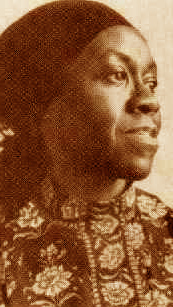
 Gwendolyn
Brooks
Gwendolyn
Brooks
(1917-2000)
Gwendolyn Brooks was born in Topeka, Kansas, on June 7, 1917. While still an infant, she and her family moved to Chicago. She began writing at 11 when she mailed several poems to a community newspaper in Chicago to surprise her family. Her early works were mostly autobiographical, detailing the death of friends, her relationship with her family and their reaction to war and racism. Brooks was educated in an integrated high school and graduated from Wilson Junior College in 1936. Although she grew up in the slums of Chicago, she made history by becoming the first African American to win a Pulitzer Prize. Her influence on poetry was incalculable. At a time when black people were being clubbed into submission because of their race, it was her poetry's eloquence that got many African-Americans to look at their community, and to see their minds as something of great worth. She published her first of 20 books in 1945, A Street in Bronzeville. Five years later, in 1950, she became the first African American to win a Pulitzer Prize in poetry for Annie Allen. President John F. Kennedy invited her to read at the Library of Congress in 1962, and in 1985 she was appointed poetry consultant to the library. In 1968 she was named poet laureate of Illinois. In 1989, Brooks received a lifetime achievement award from the National Endowment for the Arts. She was named the 1994 Jefferson Lecturer by the National Endowment for the Humanities, the highest honor bestowed by the federal government for work in the humanities. Along with her husband, Henry Blakely, who she married in 1938, she lived in a kitchenette apartment in Chicago's South Side where they raised two children. Gwendolyn Brooks promoted an understanding of black culture through her candid, compassionate poetry. She wrote hundreds of poems, had more than 20 books published. She died from cancer on December 3, 2000.